
Primary Category Lead focus
- Details
- Written by: J C Burke
- Category: CHP SOLUTIONS
- Hits: 206
POSITION PAPER & PRESS RELEASEINTEGRATED URBAN METABOLISM
|
FOR IMMEDIATE RELEASE | Distribution: Investment media, energy sector press, property & construction press, policy editors PDF Available to Download
IUM DECLARES ENERGY EFFICIENCY INDEPENDENT
The case for transforming city energy systems rests entirely on engineering physics and arithmetic — not on contested climate scenarios
|
KEY POINT |
Integrated Urban Metabolism (IUM) delivers 80-90% energy system efficiency versus 35-50% from central power stations. That efficiency gap is an engineering fact. Its value to investors is arithmetical. It requires no theory of atmospheric physics to justify. |
Urbium Research Ltd today publishes its position on the relationship between its Integrated Urban Metabolism (IUM) energy framework and the contested climate policy landscape. As scrutiny of the scientific basis for net-zero policy intensifies — and as governments begin to retreat from commitments built on worst-case climate scenarios — Urbium sets out why IUM's investment case is structurally independent of climate policy, and why that independence makes it more robust, not less, as the policy environment shifts.
1. THE DISTINCTION THAT MATTERS
There are two entirely separate questions that the energy efficiency industry has carelessly conflated for two decades. The first is: does burning less fuel save money? The second is: does burning less fuel avert a climate catastrophe? The first question has a clear, arithmetical answer. The second is contested at every level — scientifically, statistically, economically and legally.
IUM is founded on the first question. It always has been. Our framework statement — published on urbium.org and repeated in every investor communication — reads explicitly:
|
“ |
IUM is not a climate policy. It is an engineering and economic proposition. Its validity does not depend on any theory of atmospheric physics. |
This is not a diplomatic hedge. It is a precise technical statement. The IUM efficiency gains are derived from thermodynamic laws and the arithmetic of energy conversion — both of which predate climate science by a century and will remain valid regardless of how climate science evolves.
2. THE PHYSICS THAT IS NOT IN DISPUTE
The following facts are not contested by any serious party and require no reference to climate science:
- Central gas power stations convert 35-50% of fuel input into useful electricity. The remaining 50-65% is discharged as waste heat through cooling towers. This is not a policy position — it is a measurable consequence of the Carnot cycle and real-world plant efficiency data.
- Combined Heat and Power (CHP/CCHP) systems achieve 80-90% overall efficiency by capturing both electrical output and thermal output from the same fuel input. The efficiency gain is approximately 40 percentage points. This is thermodynamics, not advocacy.
- Organic waste and sewage sludge contain substantial chemical energy. Thermal hydrolysis at 160°C / 6-8 bar followed by anaerobic digestion converts that energy into biomethane with measurable yield. The chemistry is well-established and commercially deployed at scale across the UK and Europe.
- Biomethane is functionally identical to natural gas and can be injected directly into the UK's existing 280,000km gas distribution network. No new infrastructure is required in most city-centre locations. This is a grid engineering fact.
- Buildings with better insulation require less energy to heat and cool. This is also not a climate position. It is basic physics, and the economics of it are straightforward: less energy consumed means lower energy bills, regardless of the source of that energy or the atmospheric consequences of burning it.
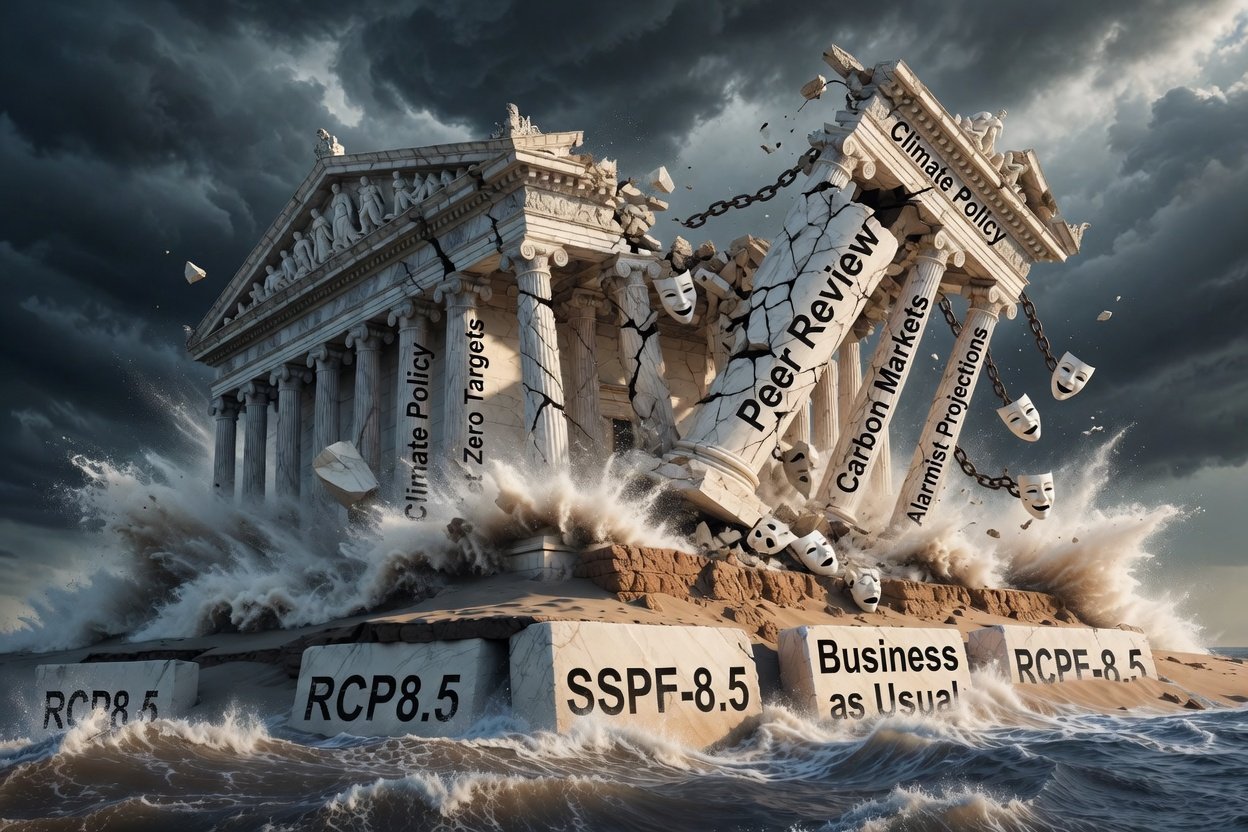
None of these facts depend on RCP8.5, IPCC sensitivity estimates, Stern Review damage functions, or any other contested element of climate modelling. They are observable, measurable and commercially deployable today.
3. WHAT IS IN DISPUTE — AND WHY INVESTORS SHOULD UNDERSTAND IT
The following elements of the dominant climate narrative are scientifically contested at a level that has material implications for investors in energy-related assets:
3.1 RCP8.5 — The Abandoned Baseline
Representative Concentration Pathway 8.5 (RCP8.5) was the worst-case scenario in the IPCC's Fifth Assessment Report, premised on coal consumption increasing approximately six-fold by 2100. It was widely used as the baseline scenario in policy documents, impact assessments and infrastructure planning — not as a tail risk, but as the expected outcome.
In 2020, Zeke Hausfather and Glen Peters published in Nature that RCP8.5 should be treated as a high-end scenario, not a likely one. By 2022, the IPCC's Sixth Assessment Report had substantially revised projected warming downwards. The scenario that justified the most alarming cost-benefit analyses for net-zero policy has been quietly retired by the scientists who created it — while the policy apparatus built on it continues largely unchanged.
|
IMPLICATION |
Any investment thesis that depends on regulatory carbon pricing, carbon credits, or net-zero mandates justified by RCP8.5 scenarios carries policy reversal risk. IUM carries none of this risk. |
3.2 Climate Sensitivity — The Range That Reveals the Uncertainty
The IPCC's Equilibrium Climate Sensitivity (ECS) — the warming expected per doubling of atmospheric CO₂ — has a stated range of 1.5°C to 4.5°C. This is not a narrow scientific confidence interval. A factor of three uncertainty in the central variable of a policy framework that is restructuring entire national economies represents an extraordinary admission of uncertainty that is rarely communicated to policymakers or the public.
The economic damage functions used in cost-benefit analyses (Stern 2006, Nordhaus 2018) are highly sensitive to this parameter. A sensitivity at the lower end of the range renders the net-present-value case for net-zero policy marginal or negative under standard discount rates. This is not a fringe position — it is Nicholas Stern’s own model applied with his own parameters at lower sensitivity.
3.3 The Policy Superstructure on Contested Foundations
The following UK policy instruments rest, directly or indirectly, on the contested scenarios and damage functions described above:
|
Vehicle Excise Duty (CO₂ banding) VED structured by g/km CO₂ output uses damage valuations per tonne that have no credible empirical basis at the precision required for a tax instrument. WLTP testing methodology is itself contested against real-world figures. EPC Ratings (Carbon-based Metrics) Commercial EPC requirements (C by 2027, B by 2030) are calibrated to carbon output rather than pure energy consumption. If the social cost of carbon is materially lower than modelled, the regulatory timeline is unjustified at its current pace — though the direction of travel towards energy efficiency remains correct. |
Net Zero Industrial Strategy The Climate Change Act 2008 (amended 2019 to net-zero) was enacted on the basis of IPCC scenarios since substantially revised. There is an emerging legal argument that the policy basis no longer matches the cited evidence base — a potential ground for judicial review. Green Gas Support Scheme Perversely, this scheme — which supports biomethane injection — is actually justified by engineering economics independent of climate science. It is one of the few net-zero policy instruments whose rationale survives scrutiny without reference to contested scenarios. |
4. THE IUM POSITION — WHAT WE STAND FOR AND WHY
Urbium Research Ltd takes the following positions, each of which we are prepared to defend in detail:
4.1 On the Basic Physics
Mild warming from elevated atmospheric CO₂ is probably real — the radiative forcing effect of CO₂ is measurable and its direction is not seriously disputed. However, the magnitude of warming, the feedbacks (particularly cloud feedbacks, the largest source of uncertainty), and the economic consequences of that warming are all contested at levels that make precision policy mandates scientifically unsupportable.
4.2 On the Policy Apparatus
The net-zero industrial complex — carbon credits, subsidy-dependent renewables, heat pump mandates, EV forcing — has been built on the foundation of high-sensitivity models and worst-case scenarios. As those foundations are revised, the policy superstructure will require revision too. Assets whose entire return depends on a subsidy or a mandate carry existential regulatory risk. IUM assets do not.
4.3 On Energy Efficiency Specifically
Energy efficiency is the one element of the net-zero agenda that requires no subsidy and no contested science to justify. A building that uses 60-70% less energy has lower operating costs. Full stop. A CCHP system that delivers 80-90% efficiency versus 35-50% from the grid earns an energy arbitrage. Full stop. These outcomes are commercially valuable whether global mean temperature rises 1.5°C or 4.5°C or remains flat.
|
OUR POSITION |
IUM would make precisely the same engineering and economic sense in a world where CO₂ had no atmospheric effect whatsoever. The efficiency gains are real. The cost savings are bankable. The asset values are supportable by reference to energy economics alone. |
4.4 On the Legal Challenges Ahead
We anticipate, and cautiously welcome, the following legal and regulatory developments:
- Judicial review of net-zero policy instruments on the grounds that the scientific evidence base has materially changed since legislation was enacted. Work by Net Zero Watch and the Global Warming Policy Foundation is moving in this direction.
- Challenge to VED CO₂ banding on the grounds that the damage valuation per tonne has no credible peer-reviewed basis at the precision required for a tax instrument, and that WLTP testing methodology systematically misrepresents real-world emissions.
- Revision of commercial EPC timelines as the government recognises that compliance costs for secondary commercial property are disproportionate relative to the contested carbon savings they are intended to deliver.
- IUM benefits from all of these outcomes. If EPC mandates are revised, distressed commercial property becomes more available for acquisition at distressed prices. If carbon policy is questioned, energy efficiency that pays for itself on pure economics is more attractive to investors, not less.
5. THE COMMERCIAL OPPORTUNITY THIS CREATES
The polarisation of the UK commercial property market — prime ESG-compliant assets at record premiums, secondary and distressed assets at 30-60% below replacement cost — is, at its root, a consequence of regulatory uncertainty built on contested science. Owners of secondary buildings are selling at distress prices because they cannot afford compliance costs whose scientific justification is increasingly questioned.
IUM's commercial strategy is to acquire those distressed assets, redevelop them with genuinely economically justified energy upgrades (not regulatory compliance theatre), and realise the value gap. The strategy works:
- If current EPC policy holds: IUM-upgraded buildings achieve compliance and command ESG premiums. Distressed vendors are forced sellers. Value gap is captured on sale or lease.
- If EPC policy is relaxed or revised: Distressed supply increases as urgency fades. IUM upgrades still deliver energy cost savings that tenants value. Acquisition prices fall further. The spread widens.
- If carbon policy collapses entirely: Energy efficiency that pays on pure economics becomes the only credible energy investment thesis. IUM is precisely that. Subsidy-dependent competitors lose their investment case. IUM's strengthens.
In all three scenarios, the IUM strategy improves or is neutral. This is the definition of a robust strategy: one that does not require a specific policy outcome to succeed.
6. SUMMARY — THE IUM INVESTMENT THESIS IN A CONTESTED WORLD
|
THE QUESTION |
IUM’S POSITION |
|
Is CO₂ warming the planet? |
Probably mildly — but magnitude, feedbacks and economic consequences are contested. IUM’s case does not depend on the answer. |
|
Was RCP8.5 a valid policy baseline? |
No. It assumed implausible coal growth. Its use as a baseline — not a tail risk — was a scientific and policy error now acknowledged by its authors. |
|
Is climate sensitivity well-constrained? |
No. IPCC range: 1.5-4.5°C. A three-fold uncertainty range in the central variable does not support precision policy mandates. |
|
Does IUM require net-zero policy to succeed? |
No. IUM’s returns derive from thermodynamic efficiency gains and energy arbitrage. These are independent of policy. |
|
What if EPC regulations are relaxed? |
More distressed assets become available at lower prices. IUM’s acquisition pipeline improves. Strategy strengthens. |
|
What if carbon policy collapses? |
Subsidy-dependent energy investments fail. IUM investments — which pay on pure economics — become relatively more attractive. |
|
What is IUM’s honest position on net-zero? |
The engineering is sound. The economics are real. The crisis narrative is contested. We separate the three, and build on the first two. |
ABOUT URBIUM RESEARCH LTD & THE IUM FRAMEWORK
Urbium Research Ltd is the developer of the Integrated Urban Metabolism (IUM) framework — a city-scale engineering approach that treats organic wastes, sewage, heat, power and cooling as interconnected resource flows to be optimised rather than isolated costs to be managed. IUM applications include city-scale CCHP networks drawing on biomethane from waste streams, distressed commercial property redevelopment to EPC A-B standards, and care home micro-city design. All IUM applications are evaluated on engineering physics and commercial economics, without reference to contested climate policy.
Founder: John C Burke (50 years construction and energy systems; IUM/CCHP pioneer; Passivhaus early adopter; Milton Keynes Energy World 1986).
Contact: | urbium.org | sun-earth-energy.com | chp4.org
ENDS
This document may be reproduced in full or in part with attribution to Urbium Research Ltd.
- Details
- Written by: J C Burke
- Category: CHP SOLUTIONS
- Hits: 236
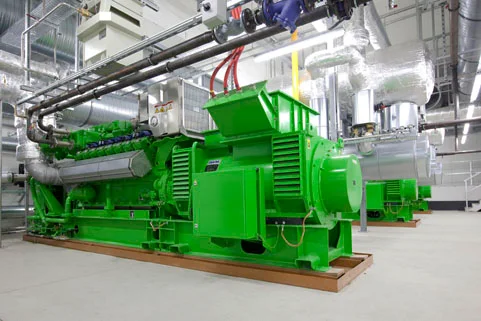 That title is a mouthful but - all possible!
We have created a desk-top study of the energy generation AND energy efficiency Upgrades POSSIBLE for just LONDON - and this would be replicatable for all major cities in the UK and a great many Towns too. If only there was the political WILL to target:
- Energy Efficiency
- Organic Wastes to Bio-Methane - distributed via the UK's extensive Gas Grid/Network
These two easy to understand concepts, would also achieve substantial inroads into the current targets of CO2 reductions and Decarbonisation - as demanded by Government
Back to our Study, in the concluding remarks we have:
The integration of thermal hydrolysis, conversion of incineration to digestion, and deployment of biomethane-fuelled trigeneration systems across London represents a transformational opportunity:

- Details
- Written by: John Burke - Sun Earth Energy Ltd
- Category: CHP SOLUTIONS
- Hits: 779
In confidence to our connections and potential investors only as a topic for further discussion, land acquisition and funding!
#housing; #WFH; #community; #zeronetenergy; #biodigesters; #employment; #commerse; #decentralisedenergy; #longtermfunds.
We need to “re-introduce” ‘Garden Cities’ these are important concepts, with enormous potential to;
- firstly, cope with immediate and vital volume housing demand.
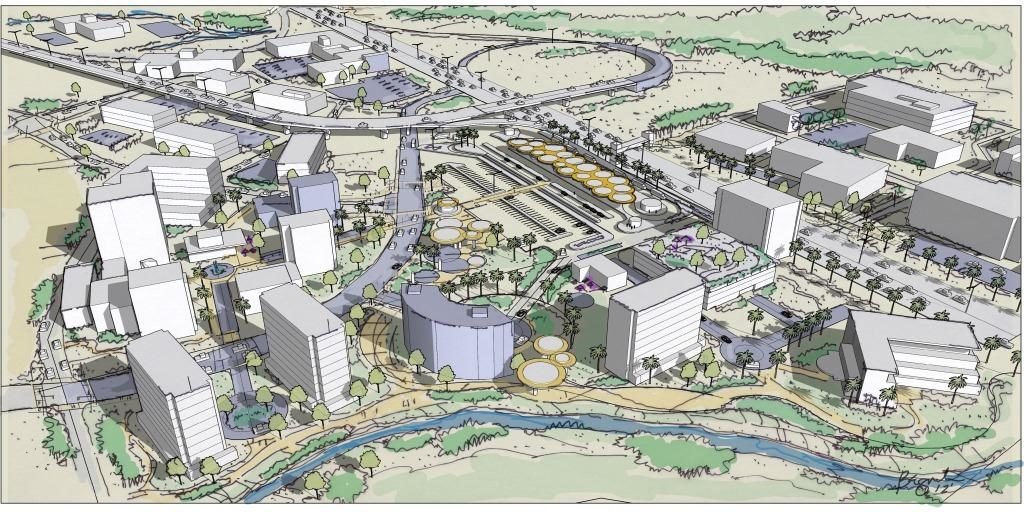
- Secondly, it gives an opportunity to allow inhabitants to take control of their “decentralised” Energy costs -
- not to be subservient to inefficient centralised energy and
- variable wholesale energy costs.
- Thirdly, The ‘Net Zero’ agenda mis-casts bio-methane as a ‘fossil fuel’ - clearly it is not; it’s a vital feedback loop between organic wastes, farm wastes, sewage etc to allow energy generation via CHP (combined Heat and Power) and even transport fuels!
- Permaculture Farming locally for food security - so all the farming aspects will 'encircle' the Garden City!
Let nothing go to waste!
With local 'farming' [Permaculture Techniques - including Allotments and many 'Community Farms'] as an important addition to these New Garden Cities, we move away from the strategy of "Just-in-Time" (JIT) deliveries, and back to a locally adapted community.
Lastly, we suggest that such a development would be - not just ‘Net Zero’ but ‘Negative (below) Zero’!! Taking Carbon (dioxide) and the much more damaging methane, out of the 'equation' as it were.
Key Technologies
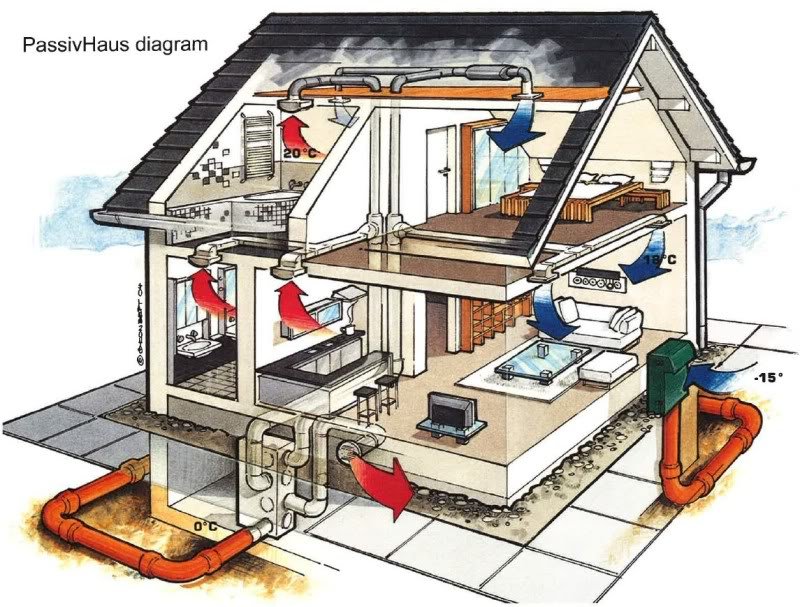
- Modular Building Technologies [Passive House Standards - as minimum]
-
- Concrete Panels
- Timber Frames
- Earth Panels
- Passive Heating and Cooling Designs
- Basements as standard
- Rainwater Harvesting
- Hot Water Storage
- Batteries/Inverters
- Broadband Fibre Distribution
- Recording of energy usage/performance
- Pre-heated incoming air via 'Earth Pipes'
- Heat recovery from exhaust air/ventilation
- Bespoke Construction - Commercial, Schools, Hospital, Offices, Hot Desks
- Concrete - Low Carbon Mix
- Adapted systems as for Housing above
- 'Active' Landscaping [to reduce heating and cooling 'loads']
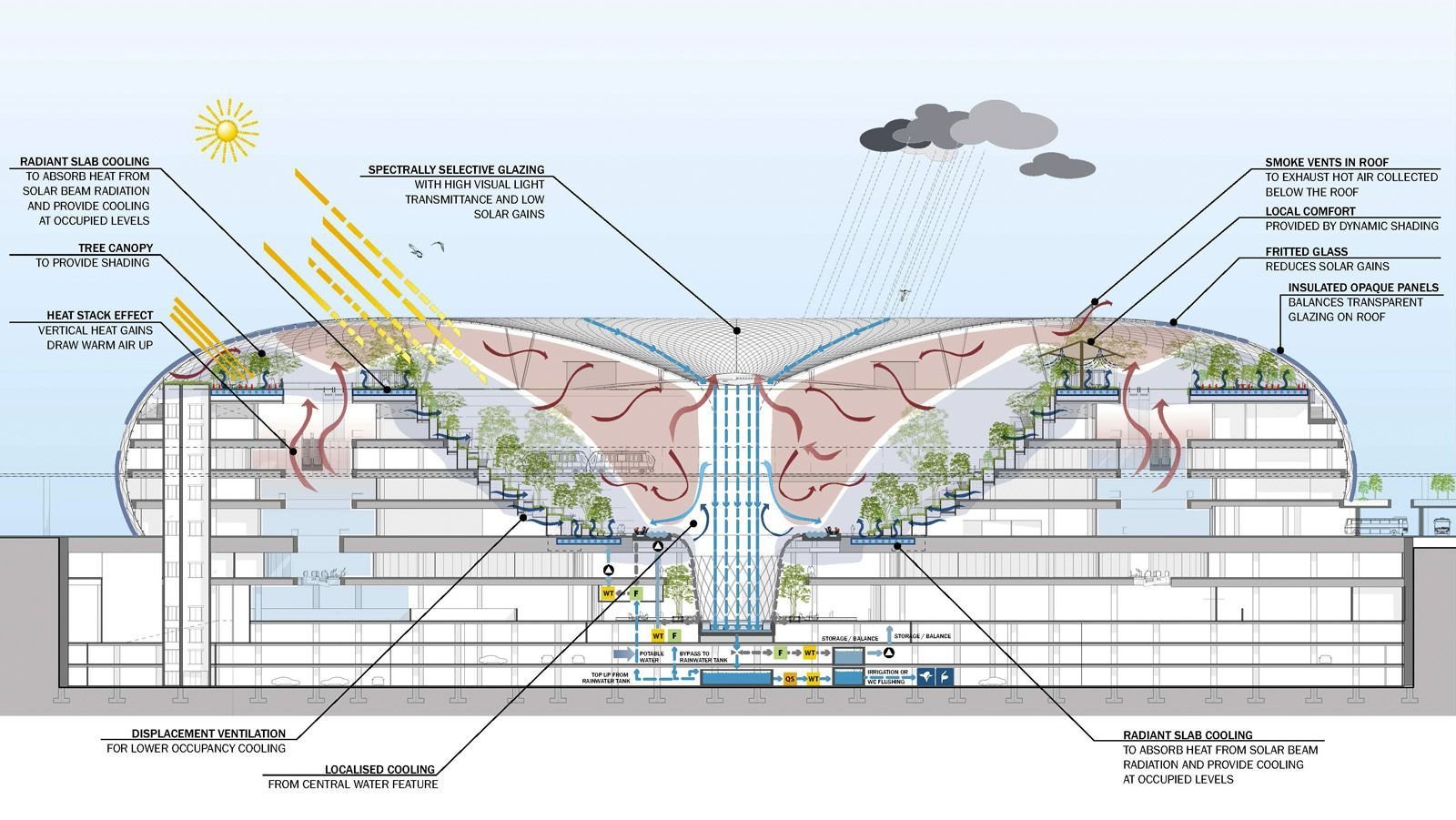
- Passive Heating and Cooling 'technologies' [minimises 'imported' energy]
- Landscaping to aid lower energy needs
- Avoid Windchill effect [Northern Exposure]
- Cooling Summer Effects
- Earthworks and planting to achieve these additional; passive effects
- Topography 'Design' to guide breezes and wind
- Trees and Micro Climate control
- Bio-Methane Production
- From Sewage and Organic Wastes [locally]
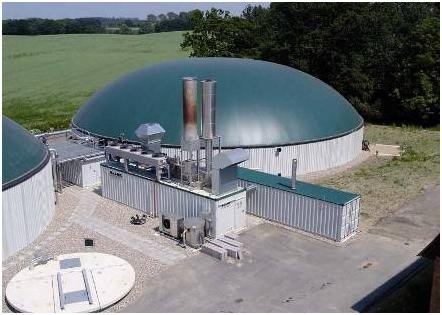
- Local Community Farming and Landscaping wastes
- Captured Coal Mine Methane [Remote into Gas Grid]
- Farming Bio Methane [Remote into Gas Grid]
- Initially [in our construction timeline] bio-methane from external UK suppliers
- From Sewage and Organic Wastes [locally]
- Combined Heat Power and Cooling - Using bio-methane as above
- Heat Distribution Network
- Each House or Property has Back-Up Hot Water Storage
- Large scale buffering Storage regionally
- Heat dump [swimming pool]
- Other large-scale [new and innovative] Heat Storage Technologies
- Cooling [chilled Water] Network
- Storage Buffering to commercial buildings
- Cooling for Basement Server Farm
- Heat recovery from immersion cooling system
- Power Generation - 6-10MW Electrical output
- used locally - in each home and in the commercial buildings
- exported to grid in times of "surplus"
- Stored into batteries and developing battery technologies
- Also storage into the homes and buildings battery back-ups as needed
- Heat Distribution Network
- Vertical Axis Wind Turbines
- Multiple 10kW installations in "Local Grid"
- Smaller scale 2-5kW in individual properties for EV charging
- Possibly larger scale installations
- Micro or Mini Hydo Power - if applicable
- Micro or Mini Hydo Power
- As appropriate if viable access to rivers or streams
- 15-70Kw multiple installations
- Solar Thermal Panels [Heat]
- On individual homes if viable to heat hot wash water in summer
- Solar PV [Electricity plus Heat]
- On individual homes if viable to provide additional electricity
- Foot-Paths, Cycle-ways
- Roads
- CNG cars, buses and commercial vehicles [from bio-digesters above]
- Trams and Local Rail
- CNG or Electric dependent on energy mix as above
Strategy to Engage
Partnerships formed with
- Local or County Authorities [for Planning]
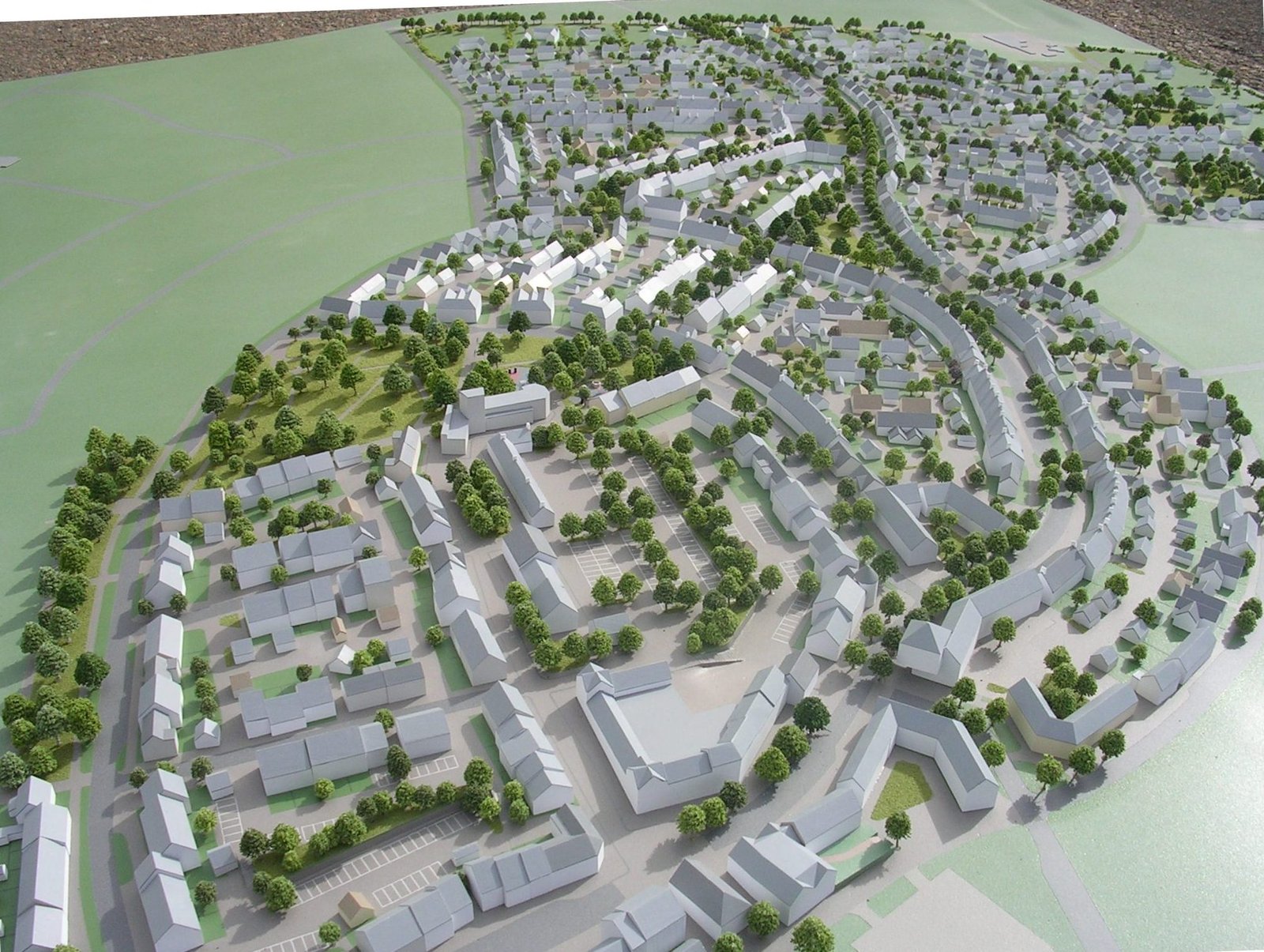
- Structure Plan integration possibilities
- Brownfield possibilities
- Housing Associations [to manage rental side -]
- Manage rental aspects and waiting lists
- and potentially land bank deals
- Energy Company [to sell back to Grid]
- Or Embedded Energy deals - as Octopus Zero Energy {electricity} Supply
- Bio-Methane Producers and Suppliers [Initial power and transport fuel needs]
- CNG Services - CNG Service Station for Buses, Lorries and Cars
- Bio-methane via the Gas Grid Supplies
- Banking or Funding Partners
- For leverage for expansion
- based on asset values and past performance