
Sovereignty, Security and Circularity
- Details
- Written by: J C Burke
- Category: Joint Venture Opportunities
- Hits: 112
 POLICY PAPER: Sovereignty, Security and Circularity
The case for distributed, biomethane-fuelled urban infrastructure in an era of contested technology sovereignty
Prepared by Urbium Research Ltd | Company No. 12104118 | urbium.org
Prepared for prospective investors and funding partners. This paper sets out the policy and strategic-sovereignty case underpinning Urbium's investment thesis; it should be read alongside Urbium's financial prospectus and technical due-diligence materials.
Executive Summary
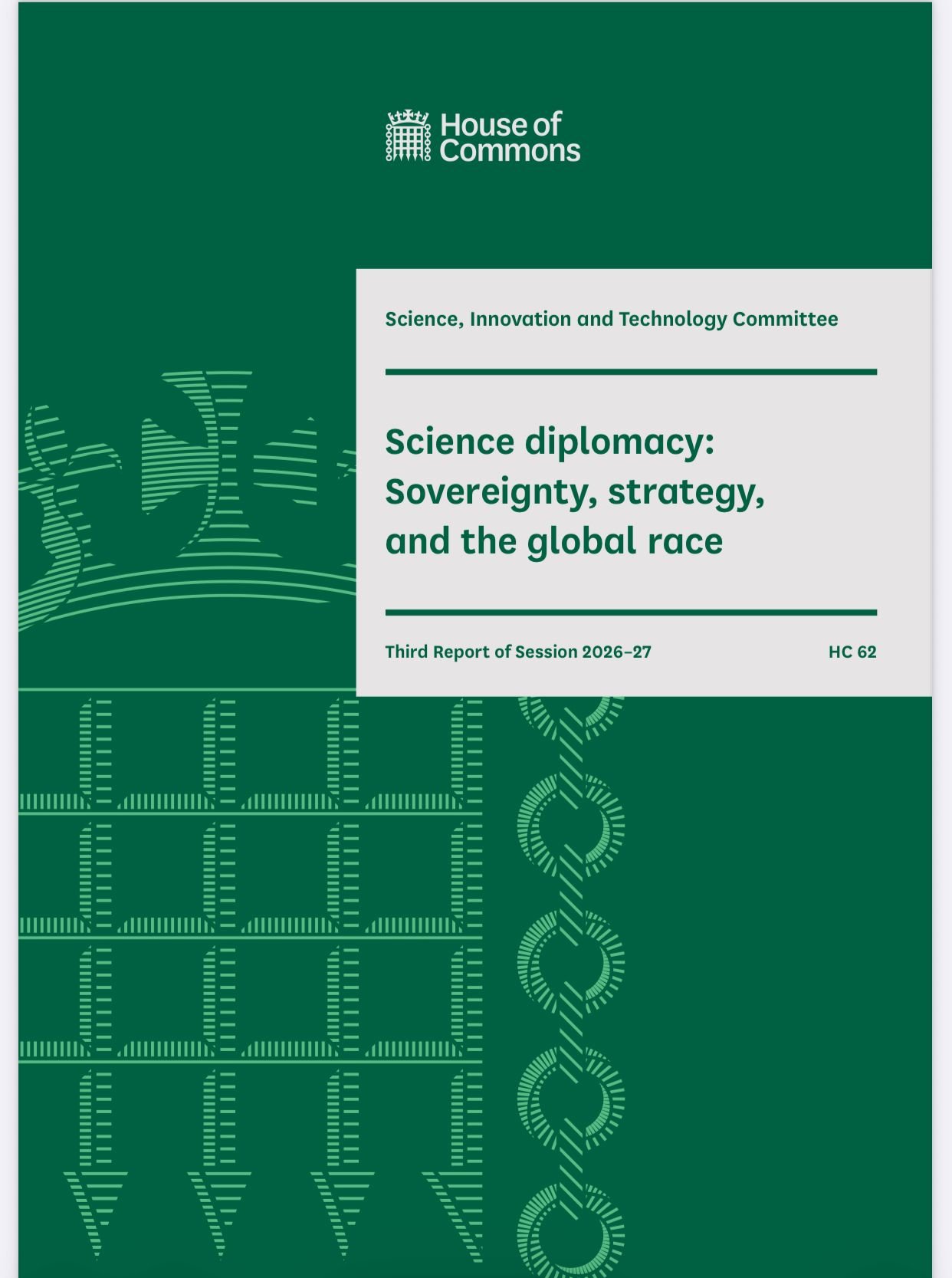
On 7 July 2026, the House of Commons Science, Innovation and Technology Committee published Science diplomacy: Sovereignty, strategy, and the global race. Its central finding is uncomfortable for a country that has long assumed its alliances guarantee access to critical technology: the United States' decision to restrict export of Anthropic's — and later OpenAI's — most advanced AI models to non-approved users demonstrated that even close allies cannot be relied upon for uninterrupted access to strategically important capability. The Committee's conclusion was unambiguous: leverage through alliance is not a substitute for owned, sovereign capacity.
Urbium Research Ltd exists to apply exactly this lesson to a domain the Committee's report does not address directly, but which is arguably more foundational than any single AI model: the energy and resource infrastructure that keeps cities running. Urbium's Integrated Urban Metabolism (IUM) model — combined cooling, heat and power (CCHP) fuelled substantially by biomethane derived from urban and agricultural waste streams — offers a distributed, self-generating alternative to a national grid and heat-decarbonisation strategy that is heavily dependent on imported hardware, single-technology mandates, and centralised infrastructure.
Displacing Electrical Load - Grid Stability
- Details
- Written by: J C Burke with Opus 4.5 Support
- Category: Grid Resilience
- Hits: 395
 Displacing Electrical Load:
The Primary Advantage of Combined Cooling, Heat & Power within the Integrated Urban Metabolism Model
Prepared by: Sun Earth Energy Ltd, IUM Programme Status: Draft for consortium and funder discussion
1. Executive Summary
The electricity grid of Great Britain — and of comparable European systems — is undergoing the fastest structural change in its history. As conventional synchronous generation retires, the system is losing the physical properties that have always kept it stable: inertia, local voltage support and fault current. The April 2025 Iberian blackout demonstrated that a grid can hold ample installed capacity and still fail in seconds when these stabilising services are absent. The binding constraint of the coming decade is therefore not how many megawatt-hours can be produced, but whether the system can remain stable while delivering them.
Against this backdrop, the way a city meets its cooling and heating demand becomes a question of grid resilience, not merely of energy efficiency. This paper sets out the central argument of the Integrated Urban Metabolism (IUM) programme: that bio-methane Combined Cooling, Heat and Power (CCHP) with absorption cooling delivers its single greatest strategic benefit by displacing electrical load from a network that is becoming less able to carry it — and, uniquely, by returning synchronous stability to the point of demand.
|
The central risk question is no longer simply whether there are enough megawatts, but whether the system can remain stable while those megawatts are being delivered. — after Kathryn Porter, Watt-Logic, “Maintaining grid stability in a wind and solar world”, June 2026 |
The case is deliberately constructed to stand on grounds that command broad agreement across the political and policy spectrum — grid security, cost, reliability and resource efficiency — and does not depend on any single contested position within the wider energy debate. Its strength is that every reviewer, whatever their priorities, finds a reason to support it.
Grid Fragility, Defensive Isolation
- Details
- Written by: J C Burke
- Category: Grid Resilience
- Hits: 247
STRATEGIC POLICY PAPER
Grid Fragility, Defensive Isolation
and the Case for Integrated Urban Metabolism
The UK's growing electricity grid crisis as a catalyst for decentralised,
bio-methane-led urban energy systems
Sun Earth Energy | IUM Research Programme
24th May 2026
|
Scholarly Input Acknowledged This paper incorporates strategic insight from @Frank_Stones (Assistant Professor, University of Oslo), whose analysis of NESO's May 2026 intraday trading restriction — published via @energygeopoliticsandstatecraft — https://energygeopoliticsandstatecraft.substack.com/p/defensive-isolation-uk-restricts • provides a timely empirical anchor for the broader structural argument developed herein. • His work on energy security, international relations, and geopolitics is gratefully acknowledged throughout. |
Executive Summary
In May 2026, the UK's National Energy System Operator (NESO) imposed a hard cap on intraday electricity trading across all five major interconnectors with continental Europe. The ceiling — 1,500 MW in aggregate, 300 MW per interconnector — is a visible symptom of something this paper has argued for several years: the UK electricity grid, conceived in the mid-twentieth century and never designed for the compound demands now placed upon it, is approaching structural limits.
This paper argues that the NESO intervention is not an isolated technical measure. It is one data point in a larger pattern of grid stress: ageing transformer infrastructure, mounting AI data centre demand, the material bottlenecks created by a copper-intensive electrification programme, an ill-sequenced heat pump rollout, and now the progressive decoupling of UK electricity markets from their continental stabilisers. Taken together, these pressures constitute a systemic risk that no amount of additional grid investment — on its own — can resolve within the timeframes required.
Energy Efficiency - vs - IPCCRCP8.5
- Details
- Written by: J C Burke
- Category: CHP SOLUTIONS
- Hits: 206
POSITION PAPER & PRESS RELEASEINTEGRATED URBAN METABOLISM
|
FOR IMMEDIATE RELEASE | Distribution: Investment media, energy sector press, property & construction press, policy editors PDF Available to Download
IUM DECLARES ENERGY EFFICIENCY INDEPENDENT
The case for transforming city energy systems rests entirely on engineering physics and arithmetic — not on contested climate scenarios
|
KEY POINT |
Integrated Urban Metabolism (IUM) delivers 80-90% energy system efficiency versus 35-50% from central power stations. That efficiency gap is an engineering fact. Its value to investors is arithmetical. It requires no theory of atmospheric physics to justify. |
Urbium Research Ltd today publishes its position on the relationship between its Integrated Urban Metabolism (IUM) energy framework and the contested climate policy landscape. As scrutiny of the scientific basis for net-zero policy intensifies — and as governments begin to retreat from commitments built on worst-case climate scenarios — Urbium sets out why IUM's investment case is structurally independent of climate policy, and why that independence makes it more robust, not less, as the policy environment shifts.
1. THE DISTINCTION THAT MATTERS
There are two entirely separate questions that the energy efficiency industry has carelessly conflated for two decades. The first is: does burning less fuel save money? The second is: does burning less fuel avert a climate catastrophe? The first question has a clear, arithmetical answer. The second is contested at every level — scientifically, statistically, economically and legally.
IUM is founded on the first question. It always has been. Our framework statement — published on urbium.org and repeated in every investor communication — reads explicitly:
|
“ |
IUM is not a climate policy. It is an engineering and economic proposition. Its validity does not depend on any theory of atmospheric physics. |
This is not a diplomatic hedge. It is a precise technical statement. The IUM efficiency gains are derived from thermodynamic laws and the arithmetic of energy conversion — both of which predate climate science by a century and will remain valid regardless of how climate science evolves.

2. THE PHYSICS THAT IS NOT IN DISPUTE
The following facts are not contested by any serious party and require no reference to climate science:
- Central gas power stations convert 35-50% of fuel input into useful electricity. The remaining 50-65% is discharged as waste heat through cooling towers. This is not a policy position — it is a measurable consequence of the Carnot cycle and real-world plant efficiency data.
- Combined Heat and Power (CHP/CCHP) systems achieve 80-90% overall efficiency by capturing both electrical output and thermal output from the same fuel input. The efficiency gain is approximately 40 percentage points. This is thermodynamics, not advocacy.
- Organic waste and sewage sludge contain substantial chemical energy. Thermal hydrolysis at 160°C / 6-8 bar followed by anaerobic digestion converts that energy into biomethane with measurable yield. The chemistry is well-established and commercially deployed at scale across the UK and Europe.
- Biomethane is functionally identical to natural gas and can be injected directly into the UK's existing 280,000km gas distribution network. No new infrastructure is required in most city-centre locations. This is a grid engineering fact.
- Buildings with better insulation require less energy to heat and cool. This is also not a climate position. It is basic physics, and the economics of it are straightforward: less energy consumed means lower energy bills, regardless of the source of that energy or the atmospheric consequences of burning it.
None of these facts depend on RCP8.5, IPCC sensitivity estimates, Stern Review damage functions, or any other contested element of climate modelling. They are observable, measurable and commercially deployable today.
3. WHAT IS IN DISPUTE — AND WHY INVESTORS SHOULD UNDERSTAND IT
The following elements of the dominant climate narrative are scientifically contested at a level that has material implications for investors in energy-related assets:
3.1 RCP8.5 — The Abandoned Baseline
Representative Concentration Pathway 8.5 (RCP8.5) was the worst-case scenario in the IPCC's Fifth Assessment Report, premised on coal consumption increasing approximately six-fold by 2100. It was widely used as the baseline scenario in policy documents, impact assessments and infrastructure planning — not as a tail risk, but as the expected outcome.
In 2020, Zeke Hausfather and Glen Peters published in Nature that RCP8.5 should be treated as a high-end scenario, not a likely one. By 2022, the IPCC's Sixth Assessment Report had substantially revised projected warming downwards. The scenario that justified the most alarming cost-benefit analyses for net-zero policy has been quietly retired by the scientists who created it — while the policy apparatus built on it continues largely unchanged.
|
IMPLICATION |
Any investment thesis that depends on regulatory carbon pricing, carbon credits, or net-zero mandates justified by RCP8.5 scenarios carries policy reversal risk. IUM carries none of this risk. |
3.2 Climate Sensitivity — The Range That Reveals the Uncertainty
The IPCC's Equilibrium Climate Sensitivity (ECS) — the warming expected per doubling of atmospheric CO₂ — has a stated range of 1.5°C to 4.5°C. This is not a narrow scientific confidence interval. A factor of three uncertainty in the central variable of a policy framework that is restructuring entire national economies represents an extraordinary admission of uncertainty that is rarely communicated to policymakers or the public.
The economic damage functions used in cost-benefit analyses (Stern 2006, Nordhaus 2018) are highly sensitive to this parameter. A sensitivity at the lower end of the range renders the net-present-value case for net-zero policy marginal or negative under standard discount rates. This is not a fringe position — it is Nicholas Stern’s own model applied with his own parameters at lower sensitivity.
3.3 The Policy Superstructure on Contested Foundations
The following UK policy instruments rest, directly or indirectly, on the contested scenarios and damage functions described above:
|
Vehicle Excise Duty (CO₂ banding) VED structured by g/km CO₂ output uses damage valuations per tonne that have no credible empirical basis at the precision required for a tax instrument. WLTP testing methodology is itself contested against real-world figures. EPC Ratings (Carbon-based Metrics) Commercial EPC requirements (C by 2027, B by 2030) are calibrated to carbon output rather than pure energy consumption. If the social cost of carbon is materially lower than modelled, the regulatory timeline is unjustified at its current pace — though the direction of travel towards energy efficiency remains correct. |
Net Zero Industrial Strategy The Climate Change Act 2008 (amended 2019 to net-zero) was enacted on the basis of IPCC scenarios since substantially revised. There is an emerging legal argument that the policy basis no longer matches the cited evidence base — a potential ground for judicial review. Green Gas Support Scheme Perversely, this scheme — which supports biomethane injection — is actually justified by engineering economics independent of climate science. It is one of the few net-zero policy instruments whose rationale survives scrutiny without reference to contested scenarios. |
4. THE IUM POSITION — WHAT WE STAND FOR AND WHY
Urbium Research Ltd takes the following positions, each of which we are prepared to defend in detail:
4.1 On the Basic Physics
Mild warming from elevated atmospheric CO₂ is probably real — the radiative forcing effect of CO₂ is measurable and its direction is not seriously disputed. However, the magnitude of warming, the feedbacks (particularly cloud feedbacks, the largest source of uncertainty), and the economic consequences of that warming are all contested at levels that make precision policy mandates scientifically unsupportable.
4.2 On the Policy Apparatus
The net-zero industrial complex — carbon credits, subsidy-dependent renewables, heat pump mandates, EV forcing — has been built on the foundation of high-sensitivity models and worst-case scenarios. As those foundations are revised, the policy superstructure will require revision too. Assets whose entire return depends on a subsidy or a mandate carry existential regulatory risk. IUM assets do not.
4.3 On Energy Efficiency Specifically
Energy efficiency is the one element of the net-zero agenda that requires no subsidy and no contested science to justify. A building that uses 60-70% less energy has lower operating costs. Full stop. A CCHP system that delivers 80-90% efficiency versus 35-50% from the grid earns an energy arbitrage. Full stop. These outcomes are commercially valuable whether global mean temperature rises 1.5°C or 4.5°C or remains flat.
|
OUR POSITION |
IUM would make precisely the same engineering and economic sense in a world where CO₂ had no atmospheric effect whatsoever. The efficiency gains are real. The cost savings are bankable. The asset values are supportable by reference to energy economics alone. |
4.4 On the Legal Challenges Ahead
We anticipate, and cautiously welcome, the following legal and regulatory developments:
- Judicial review of net-zero policy instruments on the grounds that the scientific evidence base has materially changed since legislation was enacted. Work by Net Zero Watch and the Global Warming Policy Foundation is moving in this direction.
- Challenge to VED CO₂ banding on the grounds that the damage valuation per tonne has no credible peer-reviewed basis at the precision required for a tax instrument, and that WLTP testing methodology systematically misrepresents real-world emissions.
- Revision of commercial EPC timelines as the government recognises that compliance costs for secondary commercial property are disproportionate relative to the contested carbon savings they are intended to deliver.
- IUM benefits from all of these outcomes. If EPC mandates are revised, distressed commercial property becomes more available for acquisition at distressed prices. If carbon policy is questioned, energy efficiency that pays for itself on pure economics is more attractive to investors, not less.
5. THE COMMERCIAL OPPORTUNITY THIS CREATES
The polarisation of the UK commercial property market — prime ESG-compliant assets at record premiums, secondary and distressed assets at 30-60% below replacement cost — is, at its root, a consequence of regulatory uncertainty built on contested science. Owners of secondary buildings are selling at distress prices because they cannot afford compliance costs whose scientific justification is increasingly questioned.
IUM's commercial strategy is to acquire those distressed assets, redevelop them with genuinely economically justified energy upgrades (not regulatory compliance theatre), and realise the value gap. The strategy works:
- If current EPC policy holds: IUM-upgraded buildings achieve compliance and command ESG premiums. Distressed vendors are forced sellers. Value gap is captured on sale or lease.
- If EPC policy is relaxed or revised: Distressed supply increases as urgency fades. IUM upgrades still deliver energy cost savings that tenants value. Acquisition prices fall further. The spread widens.
- If carbon policy collapses entirely: Energy efficiency that pays on pure economics becomes the only credible energy investment thesis. IUM is precisely that. Subsidy-dependent competitors lose their investment case. IUM's strengthens.
In all three scenarios, the IUM strategy improves or is neutral. This is the definition of a robust strategy: one that does not require a specific policy outcome to succeed.
6. SUMMARY — THE IUM INVESTMENT THESIS IN A CONTESTED WORLD
|
THE QUESTION |
IUM’S POSITION |
|
Is CO₂ warming the planet? |
Probably mildly — but magnitude, feedbacks and economic consequences are contested. IUM’s case does not depend on the answer. |
|
Was RCP8.5 a valid policy baseline? |
No. It assumed implausible coal growth. Its use as a baseline — not a tail risk — was a scientific and policy error now acknowledged by its authors. |
|
Is climate sensitivity well-constrained? |
No. IPCC range: 1.5-4.5°C. A three-fold uncertainty range in the central variable does not support precision policy mandates. |
|
Does IUM require net-zero policy to succeed? |
No. IUM’s returns derive from thermodynamic efficiency gains and energy arbitrage. These are independent of policy. |
|
What if EPC regulations are relaxed? |
More distressed assets become available at lower prices. IUM’s acquisition pipeline improves. Strategy strengthens. |
|
What if carbon policy collapses? |
Subsidy-dependent energy investments fail. IUM investments — which pay on pure economics — become relatively more attractive. |
|
What is IUM’s honest position on net-zero? |
The engineering is sound. The economics are real. The crisis narrative is contested. We separate the three, and build on the first two. |
ABOUT URBIUM RESEARCH LTD & THE IUM FRAMEWORK
Urbium Research Ltd is the developer of the Integrated Urban Metabolism (IUM) framework — a city-scale engineering approach that treats organic wastes, sewage, heat, power and cooling as interconnected resource flows to be optimised rather than isolated costs to be managed. IUM applications include city-scale CCHP networks drawing on biomethane from waste streams, distressed commercial property redevelopment to EPC A-B standards, and care home micro-city design. All IUM applications are evaluated on engineering physics and commercial economics, without reference to contested climate policy.
Founder: John C Burke (50 years construction and energy systems; IUM/CCHP pioneer; Passivhaus early adopter; Milton Keynes Energy World 1986).
Contact: | urbium.org | sun-earth-energy.com | chp4.org
ENDS
This document may be reproduced in full or in part with attribution to Urbium Research Ltd.
Eswatini Bio-Methane
- Details
- Written by: John Burke of Urbium Research Ltd and Locally - Fungayi Mabhunu
- Category: Seminar Schedules
- Hits: 614
ESWATINI BIO-METHANE - INFRASTRUCTURE FUND - EBMI FUND
Investment Proposal & Fund Prospectus: Transforming Eswatini's Waste Streams into Clean Energy, Economic Growth and National Energy Independence; see Concept of IUM [click here]
March 2026 | TARGET RAISE: USD $100 MILLION | CONFIDENTIAL; Fund at a Glance
|
Parameter |
Detail |
|---|---|
|
Fund Name |
Eswatini Bio-Methane Infrastructure Fund (EBMI Fund) |
|
Target Capitalisation |
USD $100 million (Phase 1) |
|
Investment Origin |
Eswatini domestic investors + diaspora; UK & Singapore co-investment |
|
Structure |
Public-Private Infrastructure (PPI) vehicle — mirroring CBMI Fund architecture |
|
Domicile |
Eswatini (operating entity) / UK or Singapore (holding/custodian structure) |
|
Target IRR |
8–12% (infrastructure-grade returns in USD) |
|
Concession Period |
20–25 years per project |
|
1:2 Multiplier Rule |
Every $1 invested = minimum $2 of in-country project spend |
|
Regulatory Alignment |
Central Bank of Eswatini + CMA framework + SACU trade alignment |
|
Target Commencement |
H2 2026 (subject to regulatory approvals and investor commitments) |
All figures indicative. Subject to regulatory approvals, investor due diligence, and Central Bank of Eswatini confirmation.
NCNDA will be required
CONFIDENTIAL — This partial extract from the full document is intended for illustrative purposes - and a full prospectus for a named recipient only can be produced - Subject to signed NCNDA - and is not to be disclosed to third parties without the prior written consent of the EBMI Fund development team. This document does not constitute a regulated financial promotion. Recipients should take independent legal and financial advice before making any investment commitment
Executive Summary
The Eswatini Bio-Methane Infrastructure Fund (EBMI Fund) is a first-of-kind infrastructure investment vehicle designed to harness Eswatini's abundant organic waste streams — from municipal sewage, solid waste and landfill sites to agricultural residues from the sugar, livestock and subsistence farming sectors — and transform them into clean, reliable, decentralised energy for the Kingdom.
Page 1 of 12