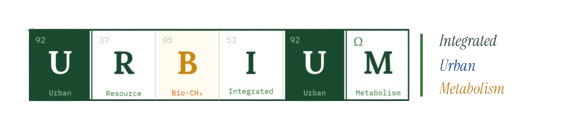
What is Integrated Urban Metabolism (IUM)?
Integrated Urban Metabolism (IUM) treats cities as living organisms with optimised resource flows — turning waste into energy, heat, cooling, and nutrients while minimising losses and imports. Developed by Urbium Research Ltd, this practical framework leverages Britain's extensive existing gas grid, urban organic wastes, and decentralised trigeneration systems to deliver high-efficiency, resilient urban energy solutions.
Unlike narrow policy approaches that focus only on electrification or large-scale heat networks, IUM emphasises **displacement** of inefficient grid electricity (for air conditioning) and gas boilers in existing buildings — especially high-rise towers — using basement-installed Combined Cooling, Heat and Power (CCHP/trigeneration) units powered by renewable biomethane. This achieves 80–90% overall system efficiency, captures waste heat that central power stations discard via cooling towers, and creates true closed-loop circularity.
The Core IUM Model
The process is straightforward, scalable, and builds on sunk-cost infrastructure:
- Urban organic waste + sewage sludge collected from households, food processing, and wastewater treatment.
- Thermal hydrolysis + anaerobic digestion — boosts biogas yield by up to 50% and produces high-quality biomethane.
- Biomethane injection into the UK's 280,000 km existing gas grid — no new pipes needed in most cases.
- Biomethane powers basement CCHP systems in existing office/residential towers: simultaneous electricity generation + useful heat + absorption cooling (via heat-driven chillers).
- Direct displacement: Replaces grid electricity for summer AC loads and gas boilers for heating/hot water — the vital efficiency gain missing from current UK heat-network assessments.
- Digestate returned as fertiliser — completes the nutrient loop back to agriculture or urban green spaces.
Result: Cities become self-sustaining metabolic systems — reducing CO₂ emissions, cutting energy imports, boosting local resilience, and generating new revenues from waste that would otherwise cost money to dispose of.
Key Advantages Over Current Policy Approaches
- Higher efficiency: 80–90% overall vs. 35–50% for centralised gas power stations (where heat is wasted in cooling towers).
- Retrofit-friendly: Installs in existing basement plant rooms — avoids disruptive flat-by-flat heat-pump retrofits or massive grid upgrades.
- Uses existing assets: Leverages the paid-for gas grid instead of replacing it; biomethane is verifiably renewable (from today's waste, not ancient sources).
- Addresses summer cooling demand: Absorption chillers turn waste heat into chilled water — perfect for rising heatwaves.
- Overcomes gas "prejudice": Even renewable biomethane faces bias from "fossil fuel" labelling — yet IUM proves it as a bridge to net zero, not a lock-in.
- London-scale potential: Could reduce ~1 million tonnes CO₂/year, generate £100–135m annual revenues, and deliver 10–12 year payback on £1.2–1.55bn investment (based on CHP4 modelling).
Why IUM Matters Now
UK policy targets 10 TWh biomethane by 2030 (Green Gas Support Scheme extended to 2030), district heating growth, and net-zero by 2050. Yet heat-network assessments overlook CCHP displacement in existing towers, and biomethane is often sidelined for "hard-to-electrify" sectors only.
Urbium Research champions IUM as the integrated solution: decentralised, efficient, circular, and ready to scale. It complements electrification, reduces global gas price exposure, and turns urban "waste" into a strategic asset.
Join the vision: Explore our Biomethane Potential Mapping research project, policy recommendations, or get in touch to collaborate on pilots.