
 POLICY PAPER: Sovereignty, Security and Circularity
The case for distributed, biomethane-fuelled urban infrastructure in an era of contested technology sovereignty
Prepared by Urbium Research Ltd | Company No. 12104118 | urbium.org
Prepared for prospective investors and funding partners. This paper sets out the policy and strategic-sovereignty case underpinning Urbium's investment thesis; it should be read alongside Urbium's financial prospectus and technical due-diligence materials.
Executive Summary
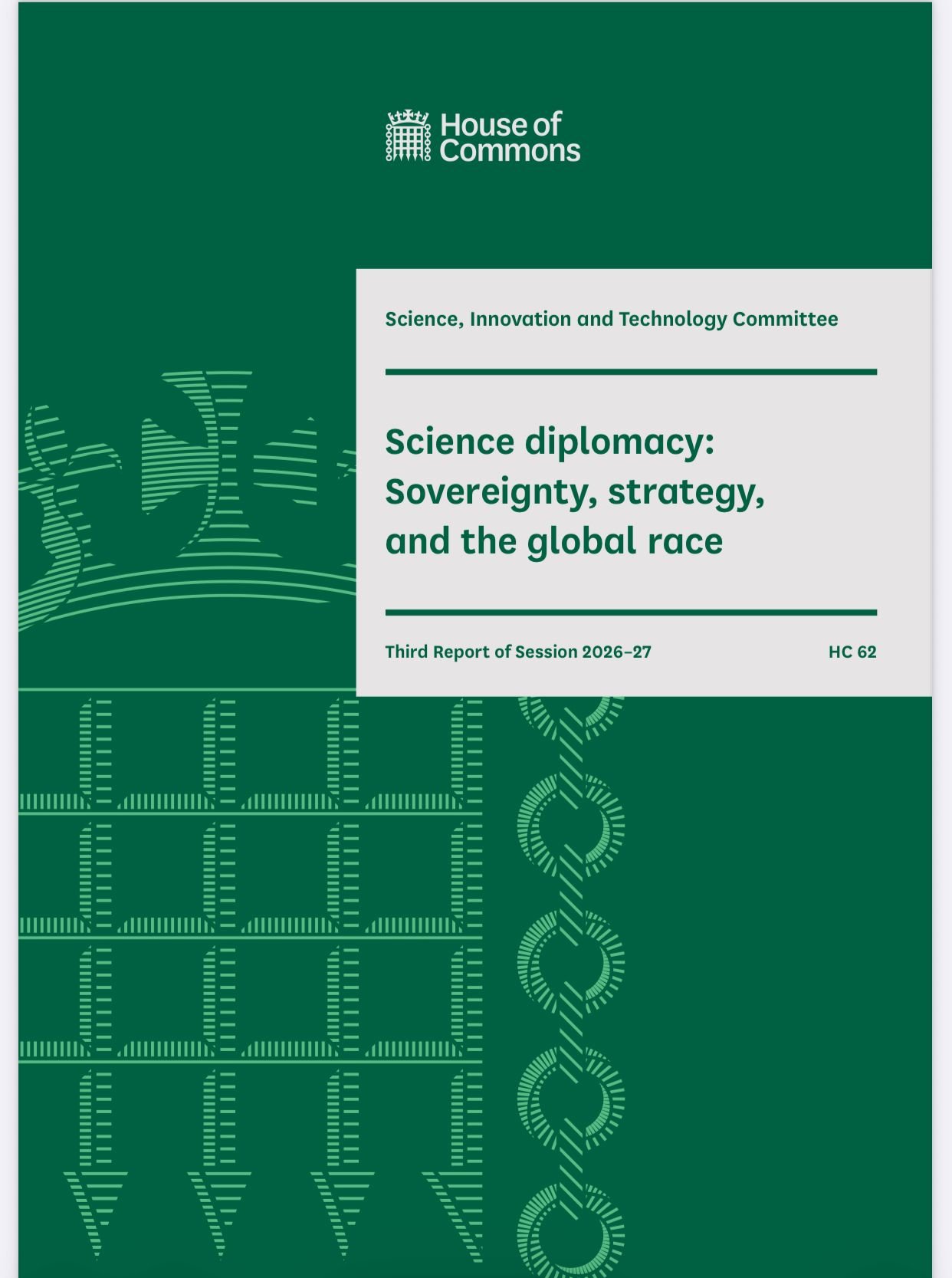
On 7 July 2026, the House of Commons Science, Innovation and Technology Committee published Science diplomacy: Sovereignty, strategy, and the global race. Its central finding is uncomfortable for a country that has long assumed its alliances guarantee access to critical technology: the United States' decision to restrict export of Anthropic's — and later OpenAI's — most advanced AI models to non-approved users demonstrated that even close allies cannot be relied upon for uninterrupted access to strategically important capability. The Committee's conclusion was unambiguous: leverage through alliance is not a substitute for owned, sovereign capacity.
Urbium Research Ltd exists to apply exactly this lesson to a domain the Committee's report does not address directly, but which is arguably more foundational than any single AI model: the energy and resource infrastructure that keeps cities running. Urbium's Integrated Urban Metabolism (IUM) model — combined cooling, heat and power (CCHP) fuelled substantially by biomethane derived from urban and agricultural waste streams — offers a distributed, self-generating alternative to a national grid and heat-decarbonisation strategy that is heavily dependent on imported hardware, single-technology mandates, and centralised infrastructure.
This paper makes three linked arguments to prospective investors and funding partners:
- Sovereignty and security: distributed CCHP nodes fuelled by domestically-sourced biomethane reduce exposure to grid failure, import dependency, and the kind of unilateral access restriction that the Committee's report identifies as a live and growing risk — not a hypothetical one.
- Circularity and resource sovereignty: the UK currently processes only a small fraction of its agricultural and sewage waste streams through anaerobic digestion, leaving a substantial, quantifiable, underused domestic energy resource that Urbium's city-network model is designed to capture.
- Regulatory tailwind, not headwind: current and prospective changes to UK energy policy — tightening EPC requirements, the Green Gas Support Scheme, and reform pressure on CHP qualification rules — increasingly favour the efficiency profile Urbium is built to deliver, even where the present framework has not caught up.
Taken together, these position Urbium not as a bet on a single technology, but as infrastructure aligned with the direction the UK's own scrutiny committees are telling government it needs to travel — sovereign, distributed, and resilient to external shock.
1. The Sovereignty Gap: What the Select Committee Found
The Science, Innovation and Technology Committee's report is a critique of government, not a statement of government policy — it was agreed by a cross-party membership spanning Labour, Conservative and Liberal Democrat MPs. Its findings nonetheless carry weight precisely because they represent formal, cross-party scrutiny of where UK strategy on technological sovereignty currently falls short. Three findings are directly relevant to infrastructure investment.
1.1 Access to critical technology cannot be assumed, even from allies
The Committee treated the US export restriction on advanced AI models as a case study with implications well beyond AI itself. Its conclusion was that “leverage may not be enough to guarantee sovereignty,” and that the UK needs to think about diversifying points of access and building genuine owned capability rather than assuming continuity of supply from trusted partners.
“The US's decision to restrict some advanced AI models should be a powerful reminder to the UK government that it may not be able to count even on its allies for access to technologies.” — Committee conclusion, paragraph 61
The direct read-across to energy infrastructure is straightforward. A national grid and heat strategy dependent on imported heat pump hardware, imported components for offshore wind, and gas supply subject to international price shocks and geopolitical disruption sits inside exactly the vulnerability the Committee is describing — a strategically important capability the UK does not itself control end to end.
1.2 The government has failed to define what sovereignty means, or how to measure it
The Committee found that government has declined to publish a definition of “sovereign capability,” citing a wish not to signal vulnerabilities to competitors. The Committee rejected this reasoning, concluding that the lack of definition mainly leaves UK companies operating without clarity on where public investment and procurement priority will actually land.
For investors, this is a relevant structural point rather than a criticism to dwell on: in the absence of a published government taxonomy of what counts as strategically owned capability, the investment case for distributed energy infrastructure cannot rest on assumed future subsidy. It has to stand on its own economics — which is the basis on which this paper, and Urbium's underlying financial model, is built.
1.3 The UK generates world-class innovation but struggles to retain and scale it domestically
The Committee's third relevant finding concerns capital, not policy. It identifies a persistent UK weakness in growth-stage investment — specialist funds, technically literate lead investors, and patient capital able to scale deep-tech and infrastructure businesses domestically rather than forcing them overseas or into early acquisition. DeepMind, founded in London and sold to Google in 2014 at a relatively early stage, is the Committee's chosen illustration of a wider pattern: strong UK science, weak UK scaling.
Urbium's positioning responds directly to this gap. It is a UK-incorporated, UK-sited infrastructure business seeking growth capital to scale a proven model across a defined network of UK cities, rather than a technology seeking to relocate for capital reasons. That distinction is itself part of the investment case this paper is making.
2. The Urbium Response: Integrated Urban Metabolism
Urbium's IUM model treats a city's energy, heat, cooling and organic waste streams as a single interconnected system rather than as separate problems for separate regulators. At the core of each node is a biomethane-fuelled CCHP (combined cooling, heat and power) plant, drawing feedstock from municipal and agricultural organic waste — sewage sludge, food waste, and livestock slurry and manure — processed through anaerobic digestion, with the resulting biogas upgraded to grid-quality biomethane or used directly on site.
2.1 The scale of the underused domestic resource
The UK produces approximately 82 million tonnes of livestock slurry and manure annually. Only around 3.5% of this currently passes through anaerobic digestion. Industry estimates put the potential contribution of this single feedstock stream at up to 13 terawatt-hours by 2050 — with the highest carbon abatement of any biomethane feedstock category — alongside comparable volumes available from municipal sewage sludge and food waste.
This is, in effect, a large and currently stranded domestic energy resource. It requires no import, no exposure to international commodity markets, and no dependency on a single allied supplier. It is the direct energy-sector analogue of the “owned capability” the Select Committee argues the UK should be building rather than assuming it can access through others.
2.2 The city network
Urbium's prospectus sets out a phased network across London, Manchester, Leeds/West Yorkshire, Liverpool, Birmingham/West Midlands and Bristol, selecting sites with existing sewage treatment works infrastructure, accessible agricultural hinterland, and Combined Authority-level convening power to support deployment. The design principle is deliberately distributed: a fifteen-node network with no single point of city-wide failure, each node capable of operating independently of the wider network and of the national grid if required, with grid connection retained as backup rather than as the primary dependency.
2.3 Why this constitutes energy security, not just decarbonisation
The policy framing that matters to investors is that Urbium's resilience case does not depend on carbon policy remaining stable. A node generating 80–90% of its own energy needs from on-site biomethane is substantially decoupled from wholesale gas price volatility and from grid outage risk, independent of whether the driving policy rationale in Whitehall in any given year is climate, cost, or security. This multiplies the paths by which the investment case can be validated by policy, rather than narrowing it to a single subsidy regime.
3. Regulatory Landscape: Where the Tailwind Sits, and Where It Doesn't Yet
An honest policy paper for investors needs to be candid about the current regulatory environment, which is mixed. Some elements clearly favour Urbium's model; others currently do not, and form part of the case for active policy engagement rather than passive dependence.
3.1 Supportive and strengthening
- Green Gas Support Scheme (GGSS): provides revenue certainty for grid-injected biomethane through to 2030, with an established connection process via National Gas that Urbium has mapped across its target city network.
- Tightening EPC requirements: as minimum energy performance standards for commercial and residential buildings rise, demand increases for on-site low-carbon heat, cooling and power solutions of the kind IUM nodes are designed to supply.
- Enhanced Capital Allowances: CCHP plant currently qualifies for accelerated tax relief, improving the capital efficiency of each node's build cost.
- Proven, non-experimental core technology: thermal hydrolysis and anaerobic digestion are established at scale at major UK water utilities, including Thames Water, which materially de-risks the technology component of the investment case.
3.2 Where the framework has not caught up
The Committee's own report is, in effect, a case study in exactly the kind of policy incoherence Urbium encounters at project level. CHPQA (Combined Heat and Power Quality Assurance) — the certification route through which CHP operators access Climate Change Levy and Carbon Price Support exemptions — has grown more complex over successive revisions of its Standard, with an annual, non-backdatable renewal cycle that creates ongoing compliance risk for operators. Heat Network Zone regulation has, in current draft form, been built around an electrified, heat-pump-compatible default pathway, without an equivalent whole-system carbon-accounting credit for high-efficiency CCHP or biomethane alternatives.
Urbium's position is not that these frameworks are necessarily hostile to CHP or biomethane by design; rather, that their practical, current effect is to under-reward whole-system efficiency relative to source-based technology mandates. This is a solvable regulatory gap, not a structural barrier to the underlying economics, and it is one on which Urbium has already engaged directly with DESNZ, including through its consultation response on Heat Network Market Framework regulation.
Investment implication: Urbium's base-case financial model does not assume resolution of these regulatory gaps. Where they are resolved in Urbium's favour, they represent upside to the base case rather than a dependency it is built on.
4. De-Risking the Ask: A Summary Risk Framework
The following summarises the principal risk categories relevant to funding partners and how each is currently mitigated within Urbium's model.
|
Risk |
Exposure |
Mitigation |
|
Core technology risk |
Low |
Anaerobic digestion and thermal hydrolysis are established, non-experimental processes deployed at major UK utilities. |
|
Biomethane grid injection |
Low |
Established National Gas connection process; GGSS revenue certainty; injection points mapped across the target city network. |
|
Energy price volatility |
Low |
80–90% self-generation decouples nodes from wholesale gas price spikes; waste gate fees and cooling revenue provide a non-energy income floor. |
|
Regulatory change |
Low–Medium |
GGSS support runs to 2030; tightening EPC standards increase, rather than reduce, demand for IUM-type solutions over time. |
|
Single-node failure |
Low |
Fifteen-node network design with no city-wide single point of failure; grid connection retained as backup; CCHP units show a strong operational-availability track record. |
|
PFAS in sewage sludge feedstock |
Medium |
Acknowledged sector-wide issue; design includes PFAS monitoring and adaptable digestion pathways as treatment guidance develops. |
5. What This Means for Funding Partners
Urbium is not asking investors to underwrite a policy bet. The core economics of each IUM node — waste gate fees, GGSS-supported biomethane revenue, on-site power and cooling sales, and Enhanced Capital Allowance relief — are designed to stand independently of any change in the wider regulatory environment described in Section 3. What the policy and sovereignty case in this paper adds is a second, independent layer of validation: an infrastructure thesis that sits squarely inside the direction UK cross-party scrutiny is now formally telling government it must travel, at a moment when the vulnerability of assumed technology access has become a matter of live parliamentary record rather than speculation.
For funding partners assessing strategic alignment alongside financial return, Urbium offers:
- A UK-incorporated, UK-sited infrastructure business, addressing directly the Select Committee's concern that UK-originated capability too often scales, or is acquired, overseas.
- A distributed architecture that reduces — rather than adds to — national dependency on single points of technological or supply failure.
- A feedstock base drawn from a large, quantified, and substantially untapped domestic resource, not from imported fuel or hardware.
- An active, evidenced engagement with the regulatory bodies (DESNZ, Ofgem) shaping the frameworks in which the business operates, rather than a passive dependence on future policy favour.
A full financial prospectus, city-by-city site analysis, and technical due-diligence pack are available on request to accompany this policy paper.
Urbium Research Ltd · Company No. 12104118 · urbium.org
This paper draws on the House of Commons Science, Innovation and Technology Committee's Third Report of Session 2026–27, Science diplomacy: Sovereignty, strategy, and the global race (HC 62), published 7 July 2026, and on Urbium's internal prospectus, funding-call mapping, and DESNZ consultation materials.